
Let’s start with WHY I created the Privilege Rainbow.
I have created the Privilege Rainbow as part of my contribution after these very powerful last few weeks. I hope we’ve all been navigating the momentum of the Black Lives Matter movement, which the New York Times calls “…the biggest collective demonstration of civil unrest around state violence in our generation’s memory.” (1)
The resources that have helped me the most in my journey to become an anti-racist ally have been the concise graphics that explain complex concepts. Over and over, I saw white people claiming they don’t have white privilege. I searched and searched for a resource that would help explain the concept of intersectionality, but I couldn’t find one. As a graphic designer, I turned inward to see how I could help advance this movement. I’m also seeing all of the emotional burden of educating white people falling on Black people who have zero responsibility to bring us up to speed.
Know this from the beginning – I am a white woman just trying to create something that would have helped me at the beginning of my journey. While I tried to only use data and not my own opinions, this Privilege Rainbow still isn’t THE answer to understanding intersectionality and white privilege. (You can scroll to the very bottom to view all of my sources). This is not the end all be all resource, and I recognize that. If my gathering of all of this data helps just one person in their journey to become anti-racist, I’ll be glad.
I also want to make it clear that I am not an anti-racism authority, just another journeyer learning how to become anti-racist WITH you. I’m here to learn, too. So if there is something in this blog post that you feel needs to be changed, added, or edited, please let me know in the comments below. I have so much humility with this blog post, and I’m happy to change what needs to be changed.
Last note before we really dive in- I want to make it clear that I am not profiting from this resource. There are no ads anywhere on this post. There are no affiliate links to books in this post.
My goal is for my fellow white people to understand that we all have white privilege, and then help them figure out what to do with it.
The Privilege Rainbow and Understanding Intersectionality
As I saw over and over in the dark corners of Instagram comments, the discussion of white privilege is often confused with total privilege. This concept is called “intersectionality.” The Oxford Dictionary defines intersectionality as “The interconnected nature of social categorizations such as race, class, and gender as they apply to a given individual or group, regarded as creating overlapping and interdependent systems of discrimination or disadvantage.” (2) For a more thorough look at intersectionality, read this article from YWBoston.org.
If you are a white American, you may not feel like you have white privilege because you may be experiencing oppression in other areas of your life. It’s important to note the importance of recognizing our own white privilege, because it contributes to systemic racism as a whole.
To me, the FIRST STEP in our unlearning is admitting our own white privilege. So if we don’t start with step one, we won’t continue on with the other steps, and we’ll quit entirely. I can’t let that happen!
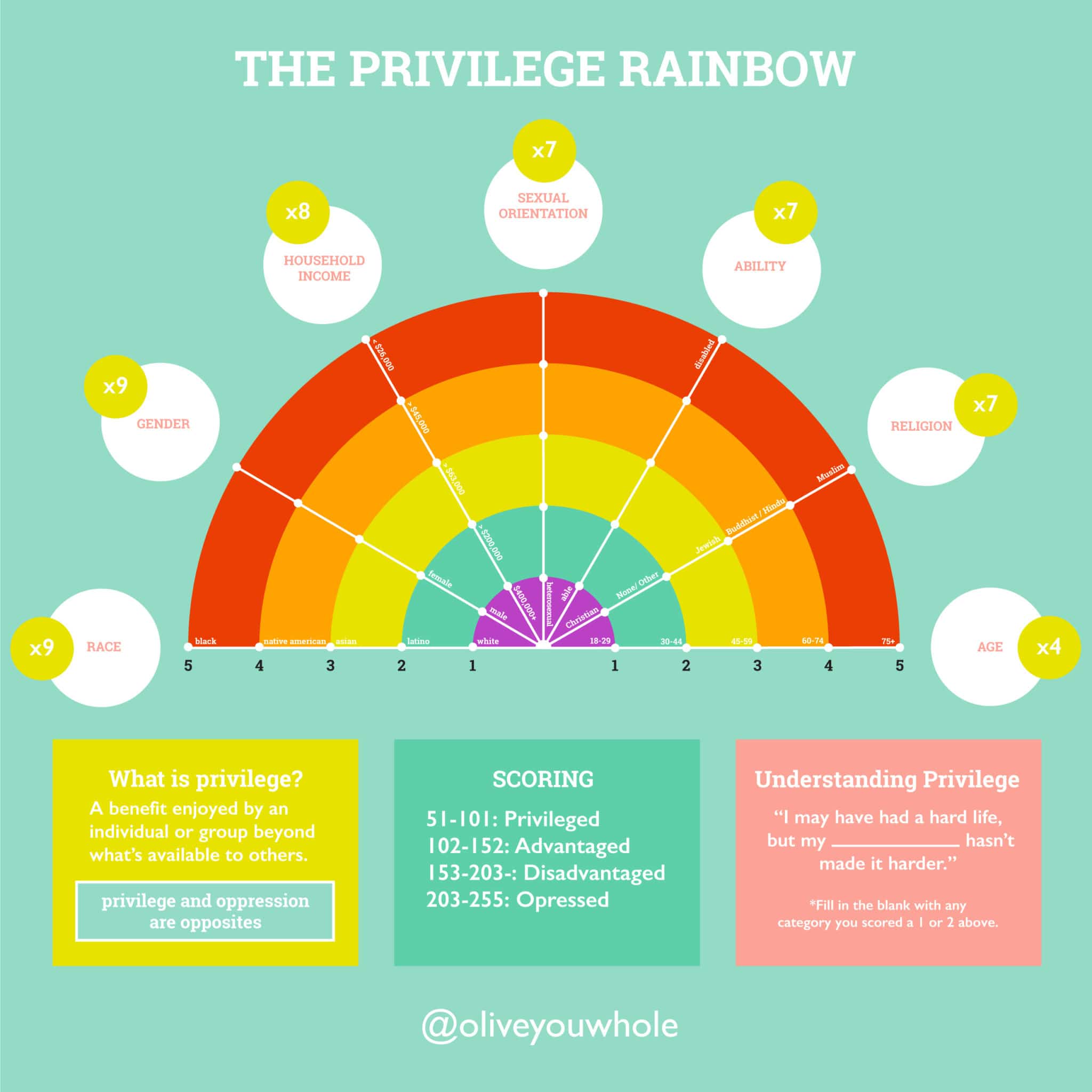
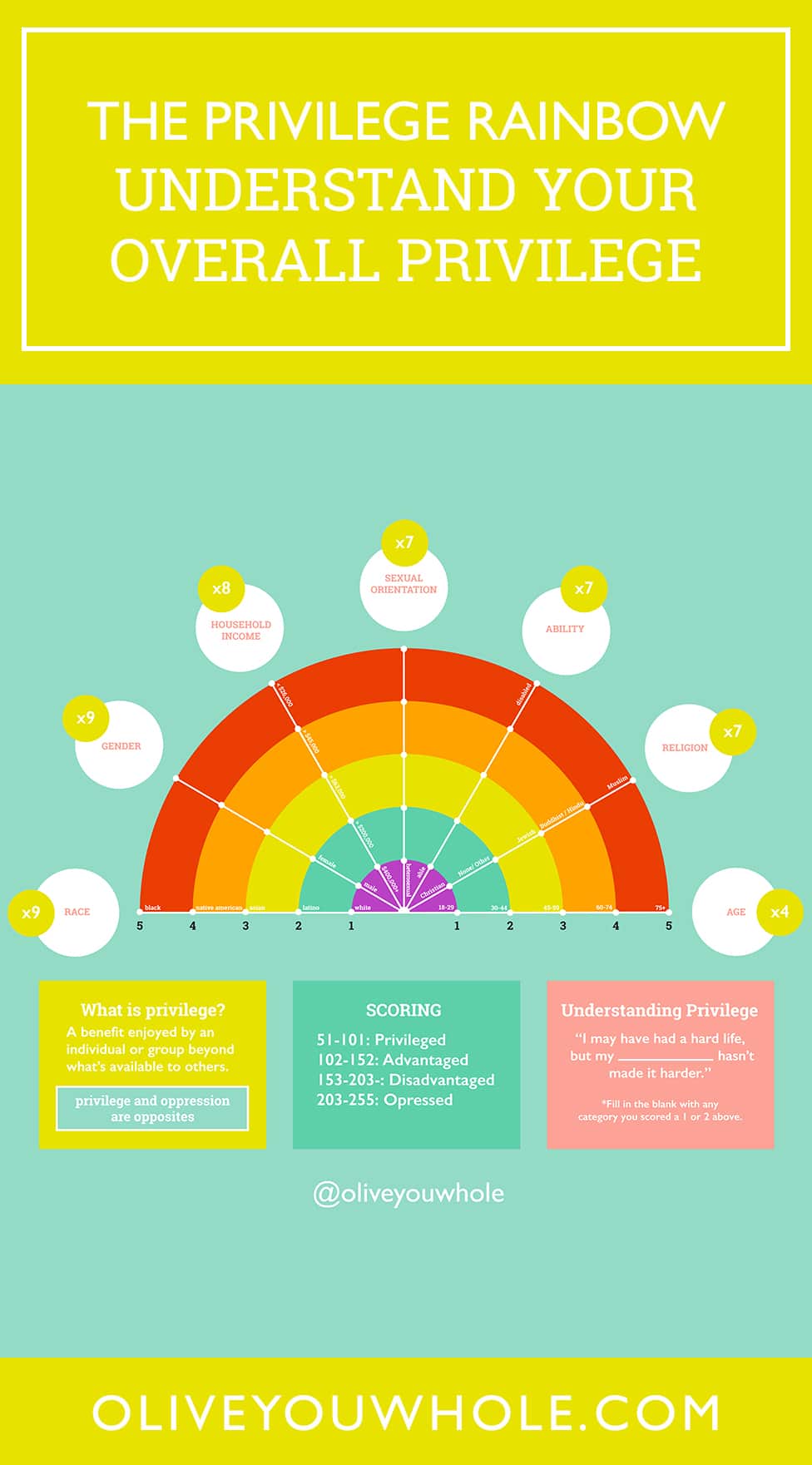
To view the Privilege Rainbow, you can save it to your desktop and zoom in (or use two fingers to zoom in on your phone). Here it is!
Who is the Privilege Rainbow for?
I created the Privilege Rainbow specifically for those of us navigating the Black Lives Matter movement and aiming for racial reconciliation in the United States. This is important to note because categories like race, income levels, and religion will have different privilege classes in other countries. If you’re in another country and you would like to use the Privilege Rainbow, you still can! Just rank yourself 1-5 based on your environment. If you are Muslim and you’re living in a country where Islam is the country’s main religion, you would rank a 1 for religion.
If you’re living in the United States, you can use the Privilege Rainbow to understand your intersectionality and overall privilege.
How does the Privilege Rainbow Work?
There are 7 categories in the Privilege Rainbow. It’s important to realize that each of these different categories has significant differences in how much “weight” they have in determining overall privilege. While this is in no way a perfect science, for determining the weight of categories, I was able to use data from the Public Affairs Council that you can see below. (3)
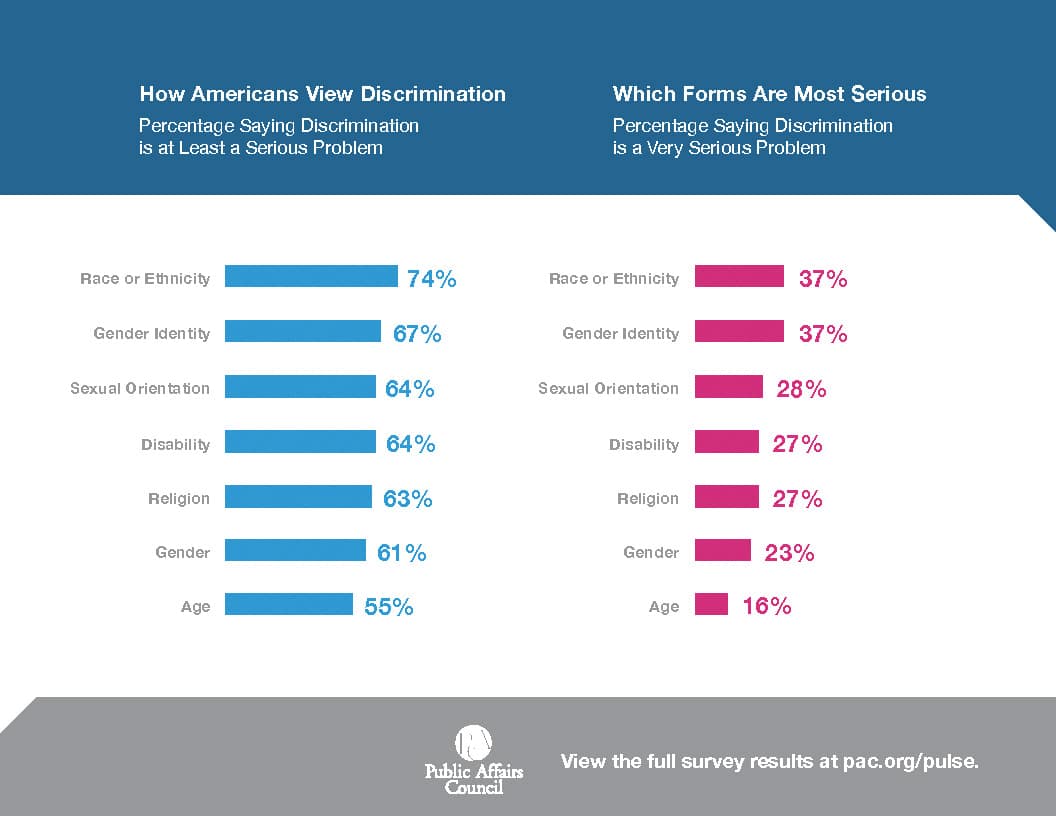
For each of these categories, I divided by 4 and rounded up to give us the multiplying factors in the Privilege Rainbow.
Additionally, the Equal Employment Opportunity Commission (EEOC) details workplace claims based on these categories. This gives us a glimpse into which types of discrimination are experienced the most. (4) The chart below also represents charges nationally. You can click on the link above to see how widely discrimination varies for different categories state by state. I found it interesting that both the graph above and the graph below have similar percentages.
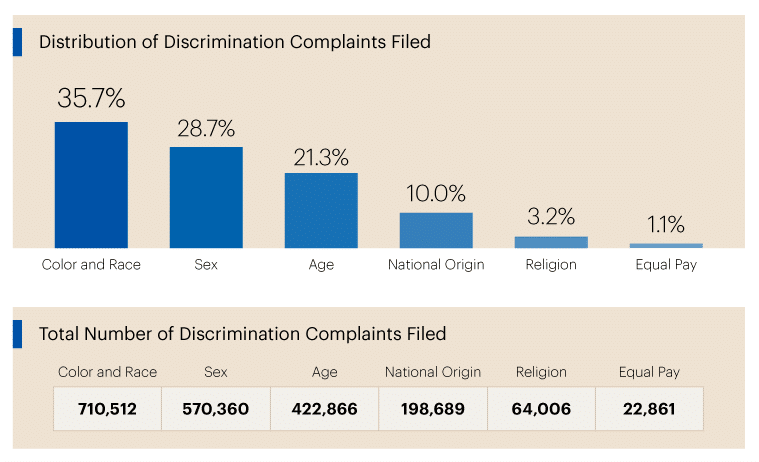
For each category, the most privilege is listed as “1.” For some categories, there are items listed for items 2-5. For these categories, I was able to find data on oppression and privilege. It is really important to me that these factors aren’t based on my opinion- for this reason, you’ll find below the data I used to create these categories and items listed 1-5.
For others that I could not find significant research, it’s up to you to decide what number your privilege is. It’s not appropriate for me to rank these different types of privilege. While the MOST privileged item may be clear, it’s unclear/ there’s no data I could find for 2-5.
For each category, you see a number 1-5 at the bottom. Choose which number you fall under, and then multiply that by the number outside of the category. Add up your answers for each category to get your total score. At the bottom you’ll see how you rank in your total privilege.
Sentence to Check Your Privilege:
If you ranked any category a 1 or 2, you have privilege in this area. Remember, having privilege in any one area doesn’t necessarily mean you have had an easy life or have overall privilege. It just means that this ONE category hasn’t contributed to your hardship.
Use this fill in the blank sentence we use with the Privilege Rainbow to check your privilege: “I may have had a hard life, but my fill in the blank with the category hasn’t made it harder.”
Let’s take a step back- what exactly does privilege mean?
Throughout this post, you’ll find definitions of important keywords here so we’re all on the same page. Anything with a source will be listed in parenthesis, and you’ll find a list of my sources at the bottom of this blog post.
Privilege
“A special right, advantage, or immunity granted or available only to a particular person or group.” (5)
Privilege and Oppression are Opposites
Where you experience privilege, there’s someone else on the opposite end of the spectrum that is being oppressed. “Privilege is inextricably linked to oppression, because, while systems, social norms, and biases are advantages for some people, there are others who are disadvantaged by those same systems, norms, and biases.” (6)
Discrimination
People who are oppressed experience much more discrimination than people with privilege in the same category, both interpersonally and institutionally. Discrimination is defined as “The unjust or prejudicial treatment of different categories of people or things.” (7)
Instances of institutional discrimination can occur (but not limited to):
- When applying to jobs
- When it comes to being paid equally or considered for promotions
- When interacting with police
- When trying to vote or participate in politics
- When going to a doctor or health clinic
- When applying to college or while at college
- When trying to rent a room or apartment or buy a house
Instances of experiences of individual or interpersonal forms of discrimination can be (but are not limited to):
- Slurs or negative words
- Insensitive or offensive comments or negative assumptions
- Sexual harassment
- Threats or non-sexual harassment
- Violence (8)
White Privilege
I appreciate this definition most from Francis E. Kendall, author of Diversity in the Classroom and Understanding White Privilege: Creating Pathways to Authentic Relationships Across Race, “having greater access to power and resources than people of color [in the same situation] do.” (9)
Before you put your guard up… Acknowledging your white privilege doesn’t mean you didn’t work hard to get where you are. It also doesn’t mean you had an easy life:
I love this conversation about White Privilege from Tolerance.org: “White privilege is not the suggestion that white people have never struggled. Many white people do not enjoy the privileges that come with relative affluence, such as food security. Many do not experience the privileges that come with access, such as nearby hospitals.
And white privilege is not the assumption that everything a white person has accomplished is unearned; most white people who have reached a high level of success worked extremely hard to get there. Instead, white privilege should be viewed as a built-in advantage, separate from one’s level of income or effort.” (10)
“Some of the most common defenses against privilege refer to the validity of personal achievement and personal struggles. People want to have total ownership of their achievements and may resist attributing aspects of their success to unearned advantages. Similarly, people may feel as though privilege somehow invalidates the reality of the challenges they faced. This is not the case. Having privilege does not necessarily mean that someone hasn’t struggled; however, those struggles can’t be attributed to the oppression of aspects of their identity that are privileged.” (11)
Something I paid particular attention to this week was white people’s response to this uprising.
Way more often than I’d like to admit, I saw white people claiming “I don’t have white privilege!”
I think the perfect example of this is Jenna Kutcher’s response to Toi Smith – she said in an email from 2017 (that she has since apologized for) “I’m struggling to come up for air after the way you spoke to me: I come from privilege? Girl, just because I’m white doesn’t mean I didn’t grow up on food stamps. You’re making incredible generalizations in your response to me.” (12)
Here’s the deal, fellow white friends. We HAVE to acknowledge our own white privilege. Why?
I find that a lot of white people agree that systemic racism still exists in America, but we’re unwilling to see our part in it. Why is this piece SO important? Because when we understand our part in upholding systemic racism, we can then help dismantle it.
“White supremacy is a system you have been born into. Whether or not you have known it, it is a system that has granted you unearned privileges, protection, and power.”
― Me and White Supremacy: Combat Racism, Change the World, and Become a Good Ancestor (13)
LET’S SKIP THE GUILT AND GET TO WORK:
Unfortunately, I’m seeing a lot of white people admit to completely skipping out on looking inside and “doing the work” because they feel they are being guilted and shamed.
That is NOT the point.
We acknowledge our own white privilege so that we can use it to help others for GOOD. (More on this below).
Acknowledging My Own Privilege
Hey there! Who am I? Great question! I’m Caroline Fausel, owner of this clean eating and lifestyle blog Olive You Whole. I am a wife and mom of 2 living in Denver, Colorado.
I rank as “Extremely Privileged” on the Privilege Rainbow that I created.
I am/ have:
- 1 – White x9 = 9
- 2 – Female x9 = 18
- 2 – A household income of $200,000+ x8 = 16
- 1 – Heterosexual x7 = 7
- 1 – Able-bodied x7 = 7
- 1 – Christian x7 = 7
- 2 – 30 years old x4 = 8
Total points = 72 (Extremely Privileged)
I shared on Instagram how participating in a “Race Race” a few years ago showed me how immense my privilege was. Unfortunately, until that moment, I had never taken the time to consider it. THAT is privilege in action. While oppressed people feel their oppression daily, it is totally possible for people with privilege to never even notice it. 😭
That’s because oftentimes, our privilege is silent to us. When we never come into contact with people of less privilege, we can’t even see our own. THAT is the problem, and that is why it continues.
People deny white privilege exists, and they’re scared to admit that they have white privilege. Acknowledging my white privilege has been transformative for me. I grew up in a culture that was very homogeneous. Within my community, about 99% of people were white, Christian, extremely wealthy, married, and heterosexual. I came to believe that this was “normal.” Unfortunately, I began to have an “us” and “them” mindset, even as a young girl. Anyone who didn’t fit into the NARROW categories above were “them” in my head. This is the problem. It’s not “us” and “them,” it’s WE. We are all one.
I believe that acknowledging my own white privilege helped me develop a “we are all one” mindset, and I hope it does the same for you.
What do I do with my Privilege?
Most of us have some privilege. I love my friend Charlotte of Confessions of a Clean Foodie‘s IGTV called “So you have privilege, be proud of that shit.” It’s 100% worth a watch – it’s only 2 minutes long. You can watch it here and follow Charlotte here.
The first step is to acknowledge our privilege.
Once we acknowledge our privilege, our eyes are opened to all of the people around us who don’t have that type of privilege in that area.
Now use your privilege for good. Become an advocate. Become a true ally for the communities less privileged than you are.
There are SO many ways to continue the journey of becoming a true ally. Here is a great list with lots of different categories with specific ways to get involved.
You’ll find more explanations and resources for each of the types of privilege below.
Racial Privilege
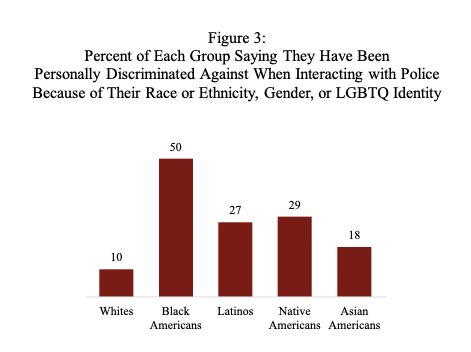
In the United States, white people have the most privilege. To determine which races are most privileged and oppressed, I used a few different data sources. The chart below from Pew Research Center is great because it shows what people of different races self-reported feeling in terms of their race helping or hurting their ability to get ahead. (14) I also pulled data from Harvard’s report entitled “Discrimination in America.” I incorporated this research, too, because it is also self-reported data and includes Native Americans. (15) For nearly every type of institutional and interpersonal discrimination, this was the order that each race felt discriminated, from least to most (just one example is below):
- White
- Asian Americans
- Latinos
- Native Americans
- Black Americans
 (14)
(14)  (15)
(15)
Gender Privilege
Men in America have the highest amount of gender privilege. Wikipedia defines male privilege as “Male privilege is the system of advantages or rights that are available to men solely on the basis of their sex. A man’s access to these benefits may vary depending on how closely they match their society’s ideal masculine norm.” (16)
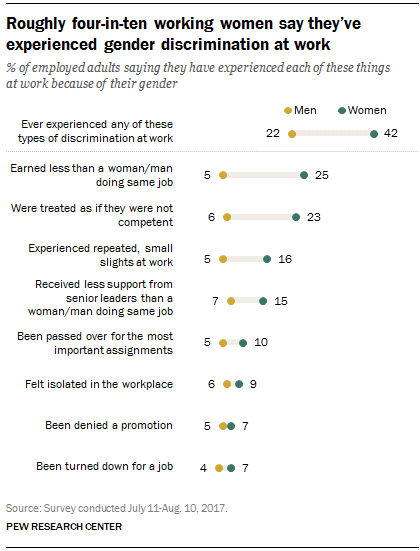 (17)
(17)
Unfortunately, as you can see above, most research on gender discrimination is still simply male or female. I couldn’t find any research on different genders’ levels of privilege. For that reason, on the Privilege Rainbow please choose your own privilege 1-5 based on your gender and the level of privilege or oppression you feel because of it.
Income Privilege (Or Class Privilege)
Class privilege is: “the subtle (and sometimes not so subtle) ways that particular groups in our society have advantages based on our access to economic resources. Privilege is related to our social class. Sociologists define social class as our overall standing in society based on things like income, occupation, and education level. Class privilege really revolves around our access to resources like money.” (18)
Urban.org has a huge study (19) showing the effects of income and wealth on health and longevity, such as:
- Risk of disease
- Feelings of worthlessness, hopelessness, and worthlessness
- Life expectancy
- Ability to afford health insurance and health care services
- Ability to afford healthy lifestyles and place-based benefits
- Access to schools, transportation, and jobs
If you want to dive into learning more about how this affects you personally, here’s an interesting quiz I found to determine your class privilege.
Sexuality Privilege
Sexuality privilege can also be called “straight privilege” or “heterosexual privilege.” If you are heterosexual, you receive benefits that those of other sexualities do not. Click here for a list of 30+ Examples of Heterosexual Privilege.
There are WAY more than just 5 types of sexualities, and I couldn’t find any research on their corresponding levels of privilege. For that reason, on the Privilege Rainbow please choose your own privilege 1-5 based on your sexuality and the level of privilege or oppression you feel because of it.
Ability Privilege
Ability privilege is “unearned and invisible social advantages held by people who are able-bodied over people who are disabled.” (20)
From LSA University of Michigan, “For example, think of a flight of stairs. Stairs are in virtually every building with more than one floor and in many outdoor spaces. It is generally assumed that people have the physical ability to walk up the stairs to access higher floors. However, a person with a physical disability that makes them unable to walk upstairs must contend with the assumption that everyone who needed to get to the second floor would have bodies that could use the stairs. The design of buildings that privileged some bodies contributed to the oppression of others.” (21)
There are WAY more than just 5 types of disabilities, and I couldn’t find any research on their corresponding levels of privilege. For that reason, on the Privilege Rainbow please choose your own privilege 1-5 based on your disabilities and the level of privilege or oppression you feel because of them.
Religious Privilege
As stated above, your religious privilege depends on the country you are in and its dominant religion. In the United States, our dominant religion is Christianity. This can also be called Christian Privilege: “Christian privilege is any of advantages bestowed upon Christians in some societies. This arises out of the presumption that Christian belief is a social norm, that leads to the marginalization of the nonreligious and members of other religions through institutional religious discrimination or religious persecution. Christian privilege can also lead to the neglect of outsiders’ cultural heritage and religious practices.” (22)
BEFORE YOU FREAK OUT.
Think about the sentence that we’re using to check our privilege, and let’s apply it to religion in America: “I may have had a hard life, but my religion hasn’t made it harder.”
Consider someone who is of a non-dominant religion like Islam, who wears something as part of their religion, like a hijab head covering. This gives their religion a visual component. Consider that judgments could be made because someone can figure out that person is Muslim just by their outward appearance.
If you are Christian (like I am!), ask yourself: have I ever faced discrimination, persecution, or oppression in America because of my religion? I know I never have been turned down for a job, excluded from a school, or stopped at airport security because of my religion.
In order to create the rankings, I combined two different sets of data. First, the percentage of Americans that claim each religion, as shown below.
Religions based on US population (23):
- All Christians combined: 70.6%
- Religious “none’s”: 22.8%
- Jewish: 1.9%
- Muslim: 0.9%
- Buddhist: 0.7%
- Hindu: 0.7%
Secondly, I combined that data with this study by Pew Research on Americans’ feelings towards different religious groups:
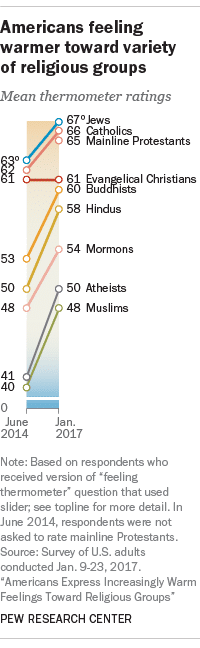 (24)
(24)
Age Privilege
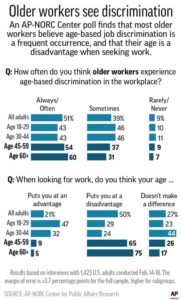 Age Privilege means you are given benefits because of your age or your perceived age.
Ageism is defined as “prejudice or discrimination against a particular age-group and especially the elderly.” (25)
The age privilege chart in the Privilege Rainbow is based of off research from the Associated Press and the order of which age groups believe their age gives them an advantage in the workplace. (26)
Other forms of privilege not included in the Privilege Rainbow:
These types of privilege definitely affect your overall privilege, but they are minimal in comparison to the categories included in the chart. I shared the data I found below on these types of privilege, but I couldn’t find any data comparing these types of privilege to those included in the Privilege Rainbow. For that reason, they aren’t included. Please still consider how the types of privilege below factor into your overall privilege.
Housing Privilege
Housing discrimination can mean two different things. First, housing discrimination can occur when people seek housing: “Many Americans of color report being discriminated against when seeking housing.” (Harvard “Discrimination in America”). “Despite long-standing laws guarding against discrimination, members of disadvantaged groups have a harder time finding a high-quality place to live in a high-opportunity neighborhood.” (27)
Secondly, the type of housing that you do have can significantly affect your privilege and life outcomes. Consider the difference between owning a home and being homeless: “Compared with children living in stable homes, homeless children are more than twice as likely to have health problems and 3 times more likely to experience severe medical problems… Homeless children are more likely than their peers to experience abuse, witness and experience violence, and have emotional trauma.” (28)
Despite one’s housing situation obviously having a huge affect on your privilege and opportunities, I couldn’t find any data comparing its statistical significance compared to the other factors on the Privilege Rainbow, so I chose to keep it off.
Education Privilege
I went into creating this graphic thinking that the higher one’s education, the lower one’s discrimination. Unfortunately, all of the data I found said that people of color actually experience more discrimination the higher their education. (Pew Research data here and Harvard study here). Privilege can be associated with one’s education level, but it seems to be determined by one’s race. Since it seems privilege and education aren’t universally applicable, I kept it off of the Privilege Rainbow.
Beauty Privilege
Beauty privilege is also called “Pretty Privilege” or “Beauty Bias.” It means “looks can create opportunities for some that isn’t as easily attainable for others. People who are considered attractive, have a certain currency that affords them more social and economic opportunities.” (29)
The REALLY IMPORTANT thing to note here is that you are beautiful no matter what!! I believe that to be a God-given gift.
Beauty privilege is based on what culture determines “beauty” to mean. Obviously, this is NOT ok. But unfortunately, people who conform to traditional, cultural views of beauty have more privilege than those who don’t.
Weight Privilege
Because of the perception of most Americans that being a “normal” weight is ideal, those that fall into this category have an advantage.
There is a stigma towards those who are overweight and obese: “Compared to normal weight persons, obese II/III persons (body mass index of 35 or higher) are more likely to report institutional and day-to-day interpersonal discrimination. Among obese II/III persons, professional workers are more likely than nonprofessionals to report employment discrimination and interpersonal mistreatment. Obese II/III persons report lower levels of self-acceptance than normal weight persons, yet this relationship is fully mediated by the perception that one has been discriminated against due to body weight or physical appearance. Our findings offer further support for the pervasive stigma of obesity and the negative implications of stigmatized identities for life chances.” (30)
If you’re looking for more examples, check out “22 Examples of Thin Privilege” here.
Height Privilege
Height is often inappropriately associated with leadership skills. Of the 43 different people who have been president, only six were under 5’8″. (31)
The opposite of height privilege is heightism, which has been defined as “prejudice or discrimination against a person on the basis of his or her height.” (32)
Look at how much height affects hiring: “Height-based prejudice permeates employment decisions—perhaps as much as race and gender. It begins with hiring. For example, when researchers asked a group of recruiters to make a hypothetical hiring decision between two equally qualified candidates who differed only in height, 72 percent of the recruiters chose the taller candidate.” (33)
Conclusions from the Privilege Rainbow
I’m impressed you’ve gotten all the way to the bottom of this post! I hope reading through it helped you recognize privileges you have that you had never realized before. Once we acknowledge our own white privilege and privilege in other areas, we can USE it to help those who have less privilege than we do.
What did you score on the Privilege Rainbow? Share any thoughts you have in the comments below.
Want to save this Privilege Rainbow Resource to dive into later? Pin it here!
Sources:
- New York Times
- Oxford Dictionary definition of intersectionality
- Public Affairs Council
- Paychex.com – data from the EEOC
- Oxford Dictionary definition of privilege
- LSA University of Michigan
- Oxford Dictionary definition of discrimination
- Harvard “Discrimination in America”
- Francis E. Kendall Understanding White Privilege
- Tolerance.org “What is White Privilege, Really?”
- LSA University of Michigan
- Jenna Kutcher + Toi Smith Email Exchange
- Me and White Supremacy: Combat Racism, Change the World, and Become a Good Ancestor
- Pew Research Center
- Harvard “Discrimination in America”
- Wikipedia Male Privilege
- Pew Research Center
- Study.com Class Privilege
- Urban.org “How are Income and Wealth Linked to Health and Longevity?”
- The Able Privilege Scale
- LSA University of Michigan
- Wikipedia Christian Privilege
- Pew Research Center: Religious Landscape Study
- Pew Research Center
- Merriam-Webster definition of ageism
- Associated Press
- Urban.org “Exposing Housing Discrimination”
- Pediatrics in Review
- The Daily Vox
- SAGE Journals
- Econlife.com
- College of William & Mary Law School
- College of William & Mary Law School



I love the rainbow! It’s such a good, tangible way to realize what I do often take for granted!! Thank you for making//sharing!!